





Articles and worked forecasts for Klamath Falls, OR businesses. Every dollar figure on this page is invented; the forecasts show the method, not any real business’s numbers.
A 13-Week Cash Flow Forecast for a Klamath Falls, OR Lodge
Illustration only, invented figures: a lodge starts with an invented $9,840 in the bank. Payroll of an invented $11,430 goes out every other week, an invented equipment payment of $1,186 leaves every fourth week, and the invented supplier and utility bills change from week to week.
| Week | Cash in | Payroll | Suppliers and utilities | Equipment payment | Ending balance |
|---|---|---|---|---|---|
| Week 1 | $9,260 | $11,430 | $3,215 | none | $4,455 |
| Week 2 | $8,915 | none | $4,080 | $1,186 | $8,104 |
| Week 3 | $8,380 | $11,430 | $2,965 | none | $2,089 |
| Week 4 | $8,740 | none | $3,740 | none | $7,089 |
| Week 5 | $7,605 | $11,430 | $3,385 | none | $121 short |
| Week 6 | $8,180 | none | $4,415 | $1,186 | $2,458 |
| Week 7 | $7,470 | $11,430 | $3,120 | none | $4,622 short |
| Week 8 | $9,415 | none | $3,655 | none | $1,138 |
| Week 9 | $10,210 | $11,430 | $2,890 | none | $2,972 short |
| Week 10 | $12,335 | none | $3,975 | $1,186 | $4,202 |
| Week 11 | $10,560 | $11,430 | $3,260 | none | $72 |
| Week 12 | $10,890 | none | $3,530 | none | $7,432 |
| Week 13 | $10,675 | $11,430 | $3,105 | none | $3,572 |
In this invented forecast the balance falls below zero in weeks 5, 7 and 9, each one a payroll week, and in week 7 it is an invented $4,622 short. From week 10 on, the invented balance stays above zero. A dip like that, seen weeks ahead, is the kind of gap a credit line draw can carry; a forecast that stays below zero for months calls for a different conversation.
How Can a Klamath County, OR Grocery Store Improve Cash Flow?
- Order closer to sell-through: smaller, more frequent supplier orders keep less cash sitting on the shelf.
- Ask suppliers about invoice terms, such as 15 or 30 days, before the next order goes in.
- Watch items that sit on the shelf for weeks and mark them down before they tie up the cash for another order.
- Move recurring bills to dates just after the main deposit days.
- Keep a small balance set aside for repairs, so a breakdown does not land in a payroll week.
- Read the card processing fees on each statement and question any line that changed.
None of these steps needs outside money for a grocery store. When a gap remains after them, a forecast shows its size and its length, and those two numbers point to a funding type.
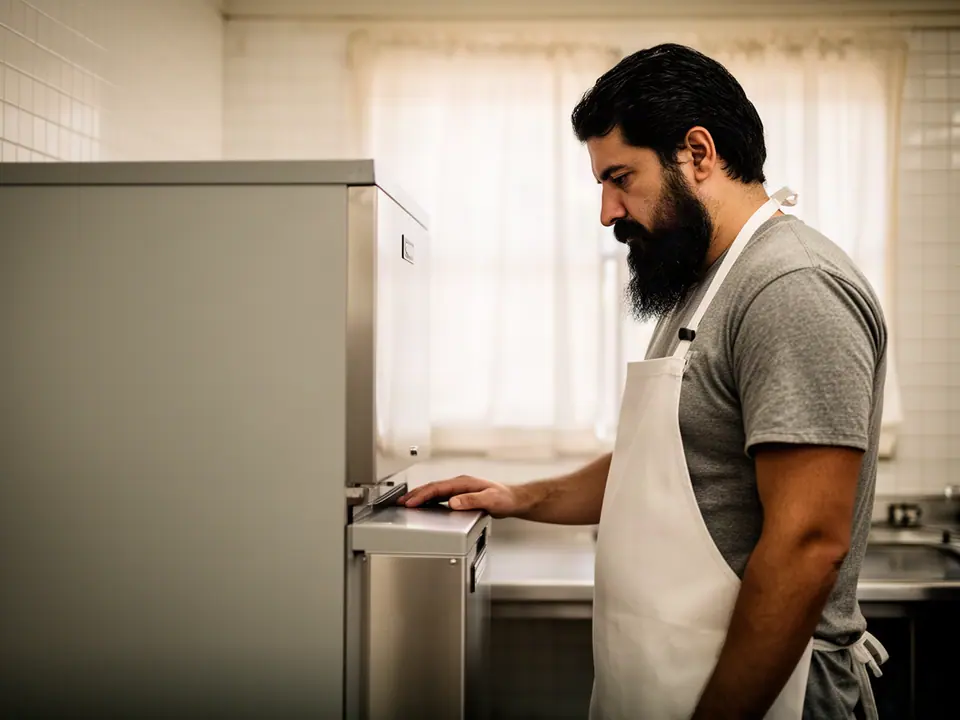
How to Prepare a Cash Flow Forecast When a Klamath Falls, OR Grocery Store’s Wrapping Machine Breaks
- Write down the opening balance from today’s bank statement.
- List expected deposits week by week, using the same weeks of recent statements as a guide.
- List every fixed payment on its real due date: payroll, rent, and loan and lease payments.
- Add the repair bill on the date the technician wants the grocery store to pay it.
- Subtract the outflows from the inflows for each week and carry the balance forward.
- Mark the first week the balance falls below the cushion you want to keep, and how many weeks it stays there.
Illustration only, invented figures: the meat department’s wrapping machine needs an invented $3,795 repair. Drawn on a line of credit at a 16.84% annual rate, with half paid back after 28 days and the rest after 56, the invented interest comes to about $73.54 (our arithmetic, daily simple interest).
Where a Forecast Gap Meets a Funding Product
A gap that closes within weeks fits a line of credit draw. A gap tied to one larger bill that pays back over a year or more fits a term loan, and a payroll stretch that ends when customer payments arrive fits working capital. The payment calculator prices the fixed-payment cases, and the worksheets page lays out a payroll-week gap the same way. Six longer cases sit in the posts: four restaurant funding sources on one prep-line quote, a motel’s turnover kit, sign and payroll wait, three dental costs on three products, a working capital loan for a lunch shift, daily, weekly and monthly short-term payments and a secured and an unsecured offer on a shop machine.
By Fairgrove Funding Group · Updated